
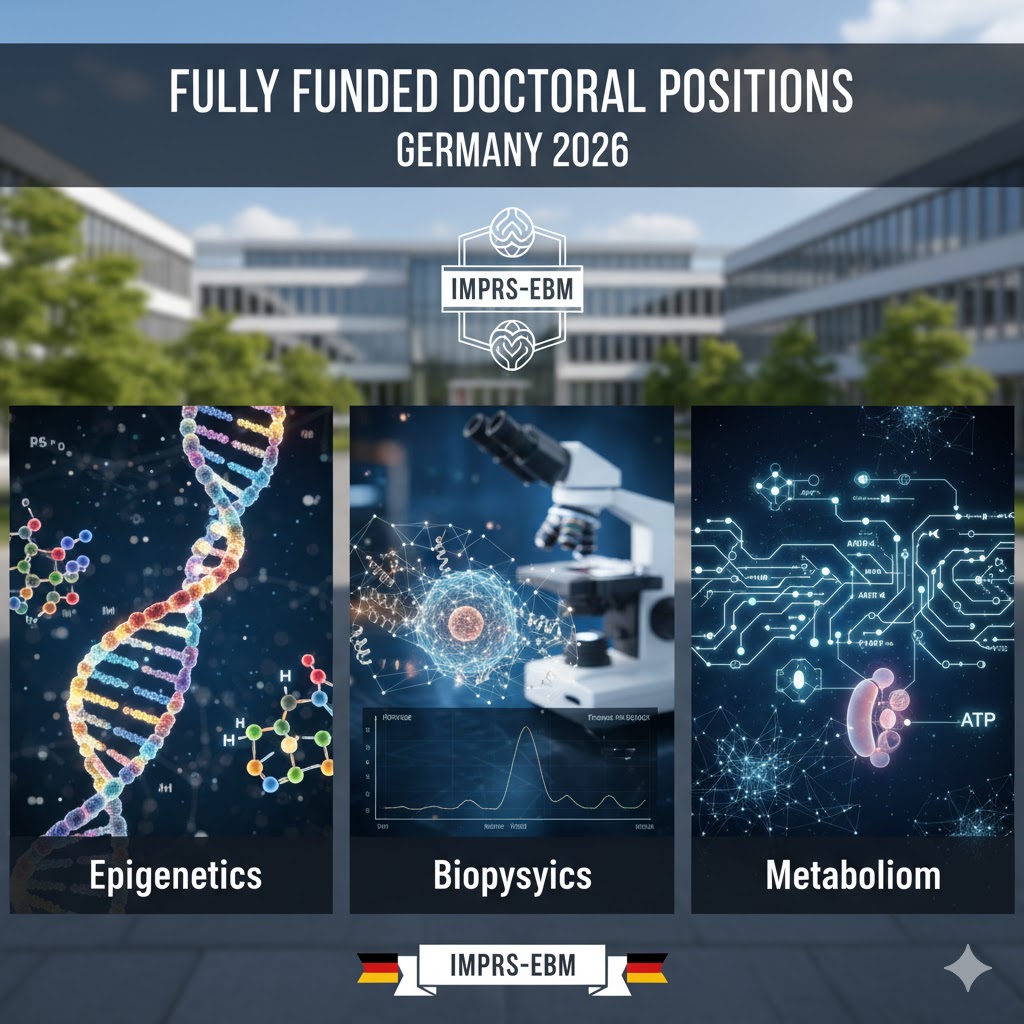

The International Max Planck Research School for Epigenetics, Biophysics and Metabolism (IMPRS-EBM) in Freiburg, Germany, is offering a remarkable opportunity for ambitious young scientists looking to pursue a fully funded doctoral degree in 2026. This prestigious program invites outstanding students from around the world to join a cutting-edge training environment focused on Epigenetics, Biophysics, Metabolism, Cell Biology, Bioinformatics, Proteomics, Functional Genomics, and related research areas. Hosted by the Max Planck Institute of Immunobiology and Epigenetics in collaboration with the University of Freiburg, the program provides access to world-class facilities, renowned mentors, high-profile academic networks, and a dynamic international community. Applications close on 06 February 2026, making this a perfect moment for aspiring researchers to take their first step toward a high-impact scientific career in Germany.
Scholarship Overview
- Scholarship Type: Fully funded PhD positions
- Degree Level: Doctoral (PhD)
- Eligible Fields: Epigenetics, Biophysics, Metabolism, Cell Biology, Biochemistry, Functional Genomics, Bioinformatics, Proteomics
- Eligible Students: International and domestic applicants
- Study Location: Freiburg, Germany
- Application Deadline: 06 February 2026
Introduction
The IMPRS-EBM program stands out as one of Europe’s most competitive research-driven doctoral pathways, designed for students passionate about understanding the molecular mechanisms of life. As global interest in biological sciences continues to rise, the Max Planck Institutes have maintained an exceptional reputation for producing high-impact research and fostering future leaders in science. The IMPRS-EBM program builds on this tradition by providing fully funded PhD positions that allow talented students to immerse themselves in advanced scientific exploration without financial burden.
With a focus on fields such as epigenetics, molecular metabolism, structural biology, and systems-level analysis of biological networks, the program bundles diverse research disciplines into one interdisciplinary training environment. Students benefit from personalized mentoring, structured training, core facility access, and participation in international conferences and workshops. The city of Freiburg adds further appeal, offering a vibrant, eco-friendly environment surrounded by natural beauty and known for its strong innovation culture and high quality of life.
About the IMPRS-EBM Program
The International Max Planck Research Schools were established to foster scientific excellence by creating specialized training centers for doctoral researchers. The IMPRS-EBM is jointly run by the Max Planck Institute of Immunobiology and Epigenetics (MPI-IE) and the University of Freiburg, two institutions recognized for pioneering research in life sciences.
Max Planck Institute of Immunobiology and Epigenetics (MPI-IE)
The MPI-IE is globally renowned for its achievements in immunobiology, epigenetics, and developmental biology. The institute hosts several interdisciplinary research groups equipped with advanced technologies in genomics, proteomics, cell imaging, cryo-EM, and large-scale data analysis. Its scientists regularly publish in top-tier journals and lead international collaborations, providing students with exceptional exposure and training.
University of Freiburg
Founded in 1457, the University of Freiburg is one of Germany’s oldest and most respected institutions. It ranks consistently among the top European universities for science and research. The university’s Faculty of Biology and Faculty of Medicine collaborate closely with MPI-IE, offering students access to a robust academic network, library systems, teaching resources, and scientific events.
Together, these institutions create a nurturing environment where early-stage researchers can develop independent thinking, scientific creativity, and valuable interdisciplinary skills. The IMPRS-EBM aims to train exceptional scientists who will contribute to advancing biological knowledge, addressing global health challenges, and leading innovations in biotechnology, medicine, and computational biology.
Why Study in Germany at IMPRS-EBM?
Germany has long been a top study destination for researchers due to its strong scientific foundations, generous funding policies, and commitment to high-quality education. The IMPRS-EBM program offers several reasons that make it an ideal choice for doctoral candidates seeking impactful academic careers.
1. Exceptional Research Infrastructure
Students at IMPRS-EBM gain access to cutting-edge research tools, including high-throughput sequencing platforms, advanced microscopy facilities, proteomics centers, cryo-electron microscopy units, and computational clusters. Such resources are rarely available in one place, making IMPRS-EBM a powerhouse for multidisciplinary research.
2. Fully Funded PhD Positions
The program covers all academic costs and provides monthly funding that allows students to focus entirely on their research. Unlike many countries where PhD students must pay tuition or rely on inconsistent funding, Germany ensures research positions are financially secure and rewarding.
3. International and Interdisciplinary Community
Students join a highly diverse cohort of researchers from multiple continents, backgrounds, and scientific traditions. This exposure enhances collaborative thinking, cultural competence, and long-term international networking.
4. Strong Career Development Support
The program includes structured training modules covering scientific writing, presentation skills, data visualization, statistics, project management, and career development workshops. Funding is also available for attending international conferences, summer schools, and specialized workshops.
5. Freiburg’s High Quality of Life
Freiburg is known for its comfortable climate, clean environment, bicycle-friendly streets, and vibrant student community. Located near the Black Forest and France-Switzerland border, it offers both scenic beauty and cultural diversity. Students can enjoy hiking, cycling, cultural festivals, and a relaxed lifestyle, fostering a balanced study-life environment.
6. Recognition and Global Prestige
A PhD associated with the Max Planck Society provides strong academic weight worldwide. Alumni from Max Planck Institutes are regularly recruited by leading universities, biotech companies, research institutes, and global health organizations.
Studying at IMPRS-EBM not only equips students with advanced scientific expertise but also positions them competitively for future research careers across academia and industry.
Scholarship Benefits
The fully funded IMPRS-EBM doctoral positions offer a wide range of benefits designed to support students academically, financially, and personally throughout their research journey.
1. Full Financial Funding
Students receive full financial support equivalent to paid research positions in Germany. This covers:
- Monthly stipend or employment contract
- Health insurance and social security contributions
- Full access to facilities and training programs
2. Professional Research Training
The program includes structured workshops, seminars, lecture series, and laboratory rotations. These help students understand diverse research perspectives before selecting a final project.
3. Training Curriculum
Students follow an adaptable curriculum offering:
- Advanced scientific courses
- Soft-skills training
- Scientific integrity modules
- Data analysis and research methodology workshops
4. Access to Core Facilities
Core facilities include genomics, proteomics, imaging, flow cytometry, bioinformatics support, and animal research centers.
5. Mentoring and Progress Supervision
Each student receives personalized mentoring from a supervisory committee made up of leading scientists. Progress is reviewed regularly to ensure academic and personal development.
6. Networking and Conference Funding
The program supports participation in international conferences, collaboration visits, and high-profile scientific meetings, enabling students to expand their academic visibility.
7. Family-Friendly Policies
IMPRS-EBM is committed to supporting students with families through:
- Childcare services
- Family working spaces
- Gender-equality initiatives
These benefits collectively create an environment where students can excel academically while maintaining personal well-being.
Eligibility Criteria
Applicants must meet several qualifications to be considered for the program:
1. Academic Requirements
- MSc, MRes, Diploma, or equivalent degree in Biology, Biomedicine, Chemistry, Physics, or a related field
- Degree must be completed by September 2026
2. Research Experience
- Practical laboratory experience
- Demonstrated involvement in scientific research projects
3. Language Requirements
- Excellent English proficiency
- Program is fully taught in English
4. Personal Qualities
- Strong motivation for scientific research
- Ability to work in a diverse, international team
- Good communication skills
5. Equal Opportunity Commitment
Applicants of all backgrounds are encouraged to apply. Individuals with disabilities and women in underrepresented research fields are given particular consideration.
Application Process
The application process for IMPRS-EBM is competitive but straightforward. Candidates are encouraged to prepare their documents carefully to improve their chances of selection.
Step 1: Review Program Requirements
Read all eligibility requirements, research areas, and faculty interests on the official IMPRS-EBM website.
Step 2: Prepare Application Documents
Typical documents include:
- Curriculum Vitae (CV)
- Motivation letter
- Academic transcripts
- Degree certificates
- Contact details of referees
- Proof of English proficiency (if available)
Step 3: Submit Online Application
Applications must be submitted through the IMPRS online portal before 06 February 2026.
Step 4: Reference Letters
Referees will be contacted to submit recommendation letters on your behalf.
Step 5: Interview Stage
Shortlisted applicants will be invited to an interview week, which may take place online or in person. During this stage:
- Candidates present their previous research
- Participate in interviews with faculty
- Meet potential supervisors
- Explore research projects
Step 6: Final Selection
Successful applicants receive an official admission offer and further instructions for enrollment and relocation.
Required Documents (80–100 words)
Applicants must prepare a complete application package that includes an updated CV, a motivation letter explaining their interest in the program, academic transcripts and certificates, proof of English-language proficiency (if available), and contact information for referees who can speak to the applicant’s academic potential. Additional documents such as research abstracts, publications, or laboratory experience descriptions may strengthen the application. All documents should be clear, well-formatted, and submitted through the IMPRS online platform before the deadline.
Deadline and Application Link
The application deadline for the fully funded IMPRS-EBM doctoral positions is 06 February 2026. Candidates interested in joining one of Europe’s most competitive biological research programs should submit their applications using the official portal on the IMPRS website.
Application Link: https://www.mpg.de/25677864/fully-funded-doctoral-positions-imprs-ebm
Conclusion
The IMPRS-EBM doctoral program represents an exceptional opportunity for young researchers eager to advance their scientific careers in one of the world’s most respected research environments. With fully funded PhD positions, access to cutting-edge facilities, comprehensive training, and mentorship from leading scientists, the program provides everything needed for academic success. Studying in Freiburg further enriches the experience through its high quality of life and vibrant scientific community. Students with ambition, curiosity, and a passion for discovery are encouraged to apply before the deadline and take a transformative step toward becoming future leaders in Epigenetics, Biophysics, Metabolism, and related fields.
About The Author


